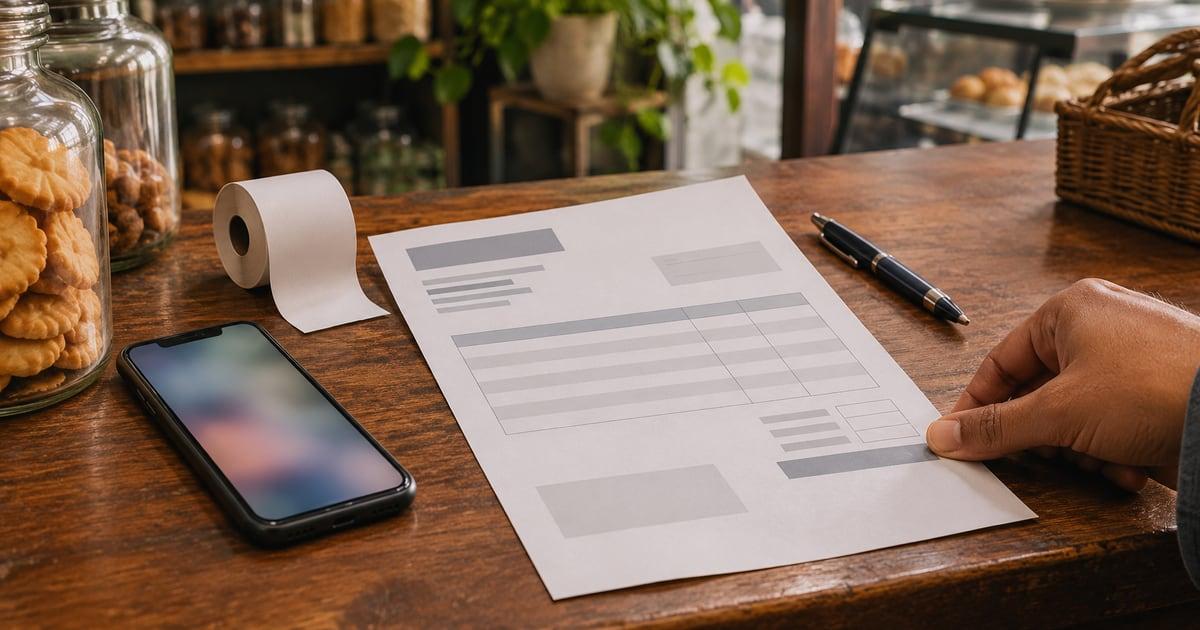
What is the right invoice billing format? It's a single page that reads top to bottom in five blocks: who you are and which invoice this is, who is paying, what they bought, how the money adds up, and how to pay. That's it. If you've ever stared at a blank document wondering whether the date goes on the left or the right (it honestly doesn't matter much), don't worry, let's go through it now. Let me explain what each block does, why it's there, and how a real bill looks when it's filled in.
What is an invoice billing format?
An invoice billing format is the fixed layout you use every time you ask a customer to pay. The content changes with each sale. The layout doesn't.
Kindly note that "invoice" and "bill" usually mean the same document seen from two sides. You send an invoice; your customer receives a bill. A receipt is the odd one out: it confirms money already paid, while an invoice asks for money that's owed.
Here is the standard shape, block by block:
| Block | Where it sits | What goes in it |
|---|---|---|
| 1. Header | Top of the page | The word "Invoice", invoice number, invoice date, supply date if different |
| 2. Parties | Under the header | Your business name, address and contact details; the customer's name and address |
| 3. Line items | The middle, as a table | Description, quantity, unit price, line total for each item |
| 4. Summary | Under the table, right-aligned | Subtotal, discount, tax, total due |
| 5. Payment terms | Bottom of the page | Due date, payment methods, bank details, any notes |
I'm a software engineer, and I build Cela myself, so I spend a lot of my day thinking about layouts. One habit from that work fits invoices well: I keep the business logic apart from the screens, because it makes everything faster to build and more consistent. With a bill, the "screen" is your layout and the "logic" is the numbers. Fix the layout once, and every new invoice is just new data poured into the same blocks.
If you came here looking for a ready-made form rather than the reasoning behind the layout, our guide to free invoice forms walks through setting one up.
Why this format works
The format isn't arbitrary. Each block answers a question that someone, at some point, will ask about the sale.
Your customer asks "what am I paying for?" The UK's Office of the Small Business Commissioner notes in its invoice guidance that vague descriptions, missing purchase order numbers, missing due dates and invoices sent to the wrong person all delay payment. A clear line-item table and payment block fix most of those.
The tax office asks "what did you sell, to whom, and when?" The UK government lists what an invoice must include: a unique identification number, your company name, address and contact information, the customer's company name and address, a clear description of what you're charging for, the supply date, the invoice date, the amounts charged, VAT if applicable, and the total owed.
In the US, the IRS doesn't publish an invoice template, but it does say you should keep supporting documents that show the amounts and sources of your gross receipts, and it lists invoices among them. A neat, numbered invoice is exactly that kind of document.
You ask "has this one been paid?" A unique number in the header lets you match each payment to its bill without guessing. When every invoice follows the same order, a missing number stands out at a glance.
When tax rules add fields
The five blocks stay the same, but tax registration adds details inside them:
- UK VAT: HMRC's VAT record-keeping guidance says a full VAT invoice needs a sequential invoice number, the time of supply, your VAT registration number, the unit price, the VAT rate and the amount excluding VAT for each item, and the total VAT. Retailers can use a simplified invoice when the supply is £250 or less, including VAT.
- India GST: the GST invoice rules ask for the supplier's GSTIN, a consecutive serial number unique for the financial year, the HSN code for goods, and the tax rate and amount for each tax charged, among other particulars.
Rules differ by country and change over time, so treat these as examples and check your own tax authority before you lock in a template.
How to lay out an invoice step by step
Let's get started. We'll build one real-looking bill together: a small hardware shop, "Bright Hardware", supplying a café with items on credit. (Both businesses are made up; the layout is the point.)
1. Write the header
Put INVOICE in large letters at the top so nobody mistakes it for a quote. Next to it:
- Invoice number: BH-2026-0147
- Invoice date: 19 November 2026
- Supply date: 17 November 2026
A small tip from the builder's side: pick a numbering pattern with a prefix and the year, then never reuse or skip a number. "BH-2026-0147" sorts properly in any spreadsheet. "Invoice for café (final) v2" does not.
2. Add both parties
Left side, your details: Bright Hardware, shop address, phone, email, and your tax number if you're registered. Right side, the customer: Corner Café, their address, and the person or department who pays bills. If they gave you a purchase order number, put it here too.
3. Build the line-item table
This is the heart of the bill. One row per item, four columns:
| Description | Qty | Unit price | Line total |
|---|---|---|---|
| LED bulb, 9 W, warm white | 10 | 3.50 | 35.00 |
| Extension lead, 4-way, 2 m | 4 | 12.00 | 48.00 |
| Interior paint, white, 5 L | 2 | 24.50 | 49.00 |
Describe items the way the customer would recognise them. "Paint" is vague. "Interior paint, white, 5 L" ends the conversation before it starts.
4. Add the summary
Right-align the maths under the table, one line each, so the eye runs straight down:
| Amount | |
|---|---|
| Subtotal | 132.00 |
| Discount (5%) | −6.60 |
| Taxable amount | 125.40 |
| Tax (example rate, 10%) | 12.54 |
| Total due | 137.94 |
Yes, this is the boring part, and it's also the part people check first. Always show the discount and tax as their own lines rather than folding them into the unit prices; it makes the bill easy to verify and matches what VAT and GST rules ask for.
5. Close with payment terms
At the bottom: Payment due: 3 December 2026 (14 days), the payment methods you accept, your bank details, and a short line such as "Please quote BH-2026-0147 with your payment." That last sentence saves you a lot of detective work later.
That's the whole format. Five blocks, one page, and the same order every time.
Common mistakes
No invoice number, or a reused one. Without a unique number you can't match payments, and UK guidance treats it as a must-have. Fix: one sequence, never skipped, never repeated.
Vague line items. "Goods supplied – 137.94" invites a phone call. List each item with quantity and unit price.
Hiding tax inside prices. If you're registered for VAT or GST, the tax needs its own line. Even if you aren't, a clear subtotal-then-total makes the bill easier to trust.
Forgetting the due date. "Payable on receipt" is fine if you mean it, but say something. A missing due date is one of the reasons the Small Business Commissioner gives for late payment.
Sending it to the wrong person. Your contact at the café may not be the one who pays. Ask who handles bills before you send the first invoice.
Calling a receipt an invoice (or the other way round). If the customer has already paid at the counter, they need a receipt. If they'll pay later, they need an invoice.
Changing the layout every month. A consistent format is faster for you and for your customer's bookkeeper. Fix it once, then only the data changes.
How Cela can help
Kindly note what the app is and isn't. It's an offline-first point-of-sale and inventory app for iPhone. Its App Store listing doesn't describe an invoice generator, so you'll still want a template for the bill itself.
Where it helps is the data that fills the line-item table. It records your sales and shows daily totals in its reports, tracks stock levels with low-stock alerts, and keeps budget and expense records, all without an internet connection. So when you sit down to bill a credit customer, the items and quantities you sold are already recorded rather than scribbled on a notepad. You can read more on the app's website or browse other shop guides on our shop blog, such as how to balance a cash drawer.
Conclusion
A good invoice billing format is boring in the best way. Header with the word "Invoice", a unique number and dates; your details and the customer's; a clear table of items; a summary with subtotal, discount, tax and total; then the due date and how to pay. Build that once, add the tax fields your country requires, and every bill after that is just new numbers in familiar places. Your customers pay faster when they can read the bill in ten seconds, and you'll thank yourself at tax time.
Frequently asked questions
What is the correct format of an invoice bill?
Put the word Invoice, a unique invoice number and the date at the top. Below that, show your business details and the customer's. Then list each item with description, quantity, unit price and line total, followed by subtotal, discounts, tax and the total due. End with the due date and how to pay.
Is an invoice the same as a bill?
In everyday use, yes: the seller calls it an invoice and the buyer often calls it a bill. Both ask for payment for goods or services supplied. A receipt is different, because it confirms that payment has already been made rather than asking for it.
Does an invoice need a number?
Yes. UK government guidance lists a unique identification number as something an invoice must include, and India's GST invoice rules ask for a consecutive serial number that is unique for the financial year. Numbering in order also makes it easy to spot a missing or duplicate bill.
What should a bill format for a shop include?
A shop bill needs the shop's name and contact details, a bill number, the date, each item with quantity and price, any discount, the tax amount if you charge tax, the total, and how the customer paid or should pay. Add the customer's name and address when you sell on credit to a business.
Do I need a different invoice format if I charge VAT or GST?
Usually, yes. A UK VAT invoice must add your VAT registration number and show VAT separately, and an Indian GST tax invoice needs details such as GSTIN, HSN code, and the tax rate and amount for each tax. Check your own tax authority's rules before you finalise a template.